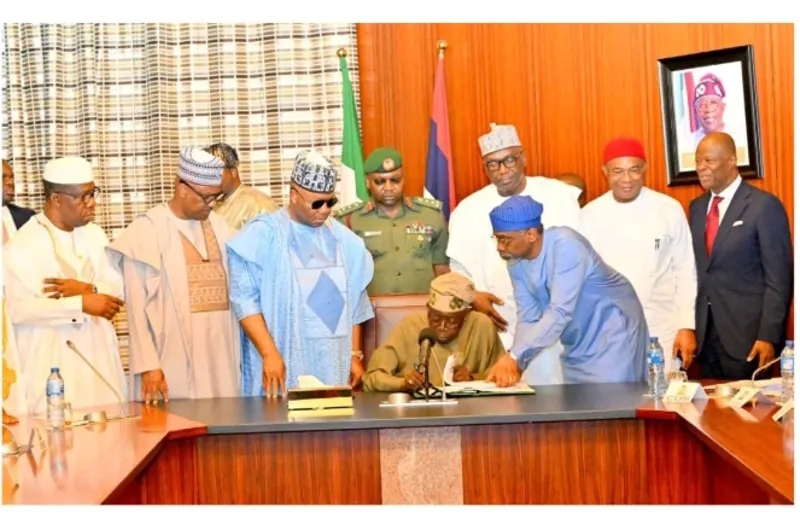
In a landmark move that signals a bold shift in Nigeria's fiscal and governance framework, President Bola Ahmed Tinubu has signed four critical tax reform bills into law. The bills, which were recently passed by the National Assembly, were signed on Thursday, June 26, 2025, during a ceremony at the Presidential Villa in Abuja.
The signing event was attended by several top-ranking government officials, including Senate President Godswill Akpabio and Speaker of the House of Representatives Tajudeen Abbas. Also present were the Senate and House Majority Leaders, as well as the chairmen of the Finance Committees in both chambers of the National Assembly. From the executive arm, the Minister of Finance and Coordinating Minister of the Economy, Wale Edun, and the Attorney-General of the Federation and Minister of Justice, Lateef Fagbemi, SAN, were in attendance.
In addition, the Chairman of the Nigeria Governors’ Forum and Kwara State Governor, AbdulRahman AbdulRazaq, and the Chairman of the Progressive Governors’ Forum and Imo State Governor, Hope Uzodimma, were part of the ceremony, underlining the wide-reaching implications of the new legislation.
President Tinubu emphasized that the four tax bills reflect his administration’s unwavering commitment to building a modern, transparent, and efficient tax system. According to him, the reforms are not merely bureaucratic adjustments but are designed to stimulate the economy, attract international investment, and reduce the tax burden on both individuals and corporate entities.
We have opened the door for new economic and business opportunities. We are showing that Nigeria is truly ready and open for business. Easy in, easy out,” the President remarked.
The newly enacted laws include the Nigeria Tax Bill (Ease of Doing Business), which harmonizes several tax laws into a single legal framework. This bill aims to eliminate overlapping regulations, reduce the complexity of tax compliance, and enhance clarity for both businesses and individuals.
Another major reform, the Nigeria Tax Administration Bill, introduces uniformity in tax administration processes across the federal, state, and local government levels. This is expected to simplify interactions with tax authorities and reduce friction between the different tiers of government.
The Joint Revenue Board (Establishment) Bill creates a national governance body tasked with overseeing and coordinating tax collection efforts across the country. This body is expected to foster cooperation and reduce duplication among tax agencies.
Perhaps the most consequential of the four, the Nigeria Revenue Service (Establishment) Bill, repeals the existing Federal Inland Revenue Service (FIRS) Act and consequently the FIRS. In its place, it establishes the Nigeria Revenue Service, a centralized authority responsible for all federal tax collection. This development is expected to significantly restructure Nigeria’s tax ecosystem and may lead to the withdrawal of tax collection mandates previously held by agencies such as the Nigeria Customs Service and the Nigerian Upstream Petroleum Regulatory Commission.
As implementation begins, observers anticipate a significant reorganization within the country’s revenue-generating agencies. The reforms are seen as a critical step toward increasing government transparency, reducing leakages, and boosting Nigeria’s non-oil revenue base.