Somewhere in Minna this week, a family learned the worst. One relative told the BBC that word came the day after the arrests: the children were dead. Then came the video. Dozens of young men lay in the open wearing only shorts, most of them apparently teenagers, while volunteers in gloves stood over them and women moved between the bodies trying to find their relatives. Those women were not looking at a statistic. They were looking for someone who had been alive and known to them a few days earlier.
We should say plainly what this was. Thirty-seven human beings died in the hands of the state, in a facility meant to hold them safely until a court could hear their cases.
What we know, and what we are being asked to believe
The dead were among scores of suspects arrested in operations around Minna on September 15 and 16. More than fifty people had been detained that week with no formal charges, while documentation and profiling were still under way. They were suspected of illegal mining. Suspected. That word matters, because nobody had proved anything, and the only sentence anyone received was one no Nigerian court could ever have passed.
The civil defence corps first blamed disease, but an intelligence report seen by AFP pointed to overcrowding and poor ventilation, and survivors recalled the panic of struggling to breathe inside the cell. The corps has since said the cause still needs medical and laboratory confirmation. Caution is right while the evidence is incomplete. But an institution that reaches for the word "disease" before any test has been run is telling us how it hopes the story will end. Even if a pathogen is eventually found, the question does not go away. Why were dozens of people held together with no medical attention, in conditions where sickness, or simple lack of air, could kill? English took the phrase "black hole" from a cell in Calcutta that was too small for the people locked in it. We should not need a new cell to relearn the lesson.
There is another detail that stays with me. The first list of the dead came from hospital records, and the last four names were supplied later by relatives. Families completed the state's count of its own dead. Grief did the paperwork that the system should have done.
What the law says, and why it matters here
The Constitution does not treat suspicion as guilt. Section 33 protects the right to life. Section 34 protects human dignity. Section 35 protects personal liberty and sets a clock on detention. Suspects are generally to be brought before a court within a day where one is nearby, or within two days otherwise. That clock is not a technicality. It exists because the hours between arrest and court are when a person is most exposed, with no judge watching and no lawyer present. Those hours are also when accountability is easiest to avoid.
President Tinubu said that suspicion of illegal mining does not remove a person's right to life, dignity, or humane treatment, and that deaths from official negligence or dereliction will not be tolerated. He is right. But every Nigerian lawyer, and every Nigerian who has waited outside a police station, knows how far a promise can be from a practice. The measure of that sentence is what happens next, and whether it is honoured in every cell in the country, not only in the one the cameras found.
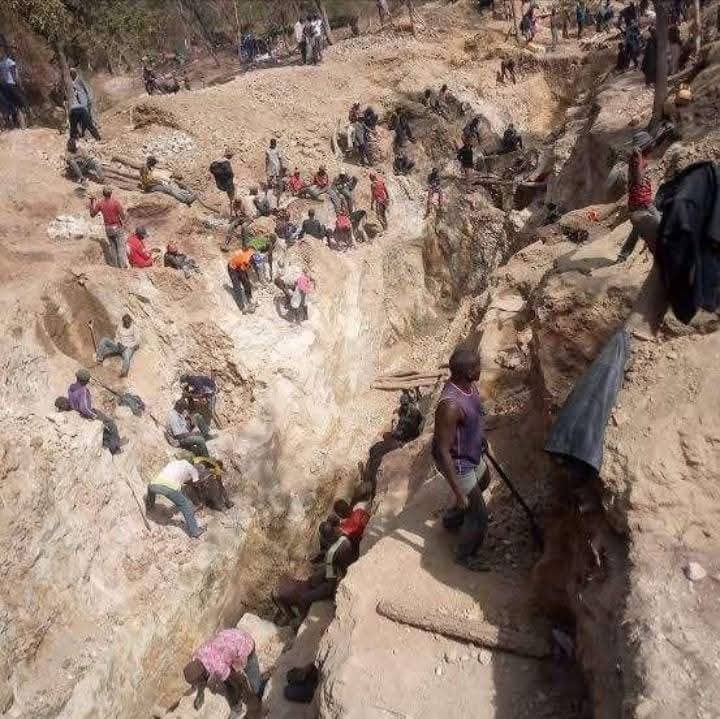
Illegal mining is a real problem, and this piece does not pretend otherwise. The scramble for gold in Niger State is feeding gangs, locally called bandits, who tax the miners and demand a share of the ore in exchange for access to the pits. A state has every right, and a duty, to confront that. But look at who actually gets arrested. Niger State is rich in minerals and draws thousands of artisanal miners, most of them lured by the hope of striking gold. Many such mines are run by criminal or armed groups, or by distant companies that exploit the miners.
The digger at the pit is usually the poorest person in the chain and the easiest to catch. The financier, the buyer, and the person who moves the gold across borders rarely sit in a cell. If our answer to a criminal economy is to lock up its labourers and lose them in the dark, we have not fought the crime. We have punished poverty and called it enforcement.
In Minna, mobs blocked a main street and attacked a transport depot, a bank, political party offices, and private businesses, while police fired shots to disperse them, and a dusk-to-dawn curfew followed. None of that is an excuse for destruction, and small traders who lost their livelihoods are victims too. But this is what happens when a state cannot be trusted to tell the truth about its own custody. Where there is no credible account, rumour fills the space, and grief turns to rage.
The governor declared three days of mourning and postponed the start of campaigning for the January elections. Several officials have been suspended. Among them is the state's civil defence commandant, Suberu Aniviye. These are first steps, and they should be acknowledged as such. Suspension is not accountability. Nigerians have watched many panels convene solemnly and report to shelves. This one has to be different.
What justice should look like
- Independent forensics. Publish the autopsy findings and cause of death, examined by pathologists who do not answer to the agency under investigation.
- Individual responsibility. If negligence or unlawful detention is established, prosecute the responsible officers and commanders by name, not only the institution.
- Real oversight of custody. Every detention facility should face unannounced civilian inspection, with capacity and occupancy figures made public.
- Truth and reparation for families. Compensation matters, but so does a full, honest account, delivered to the families first.
- A mining policy with a future. Licensing, cooperatives, and legal routes for artisanal miners would starve the gangs far better than any cell.
The names
Thirty-seven people went into that room as suspects and came out as names on a list. They were young, poor, and hopeful in the way that sends people down a pit for a chance at gold. That does not make them criminals beyond redemption. It makes them ours.
A country is measured by how it treats the people it has the power to lose. If we let this pass as a passing headline, an inquiry that fades and a suspension that ends, we will have decided that some Nigerians are cheaper than others. We must not decide that. Give the 37 a truthful inquiry, and give every Nigerian in a cell tonight the certainty that being arrested is not a death sentence.