President Donald Trump has wrapped up a four-day tour of the Gulf region, visiting Saudi Arabia, Qatar, and the United Arab Emirates. The trip, his first major overseas engagement since beginning his second term, was marked by a series of significant economic agreements and notable policy announcements.
Strategic Economic Partnerships
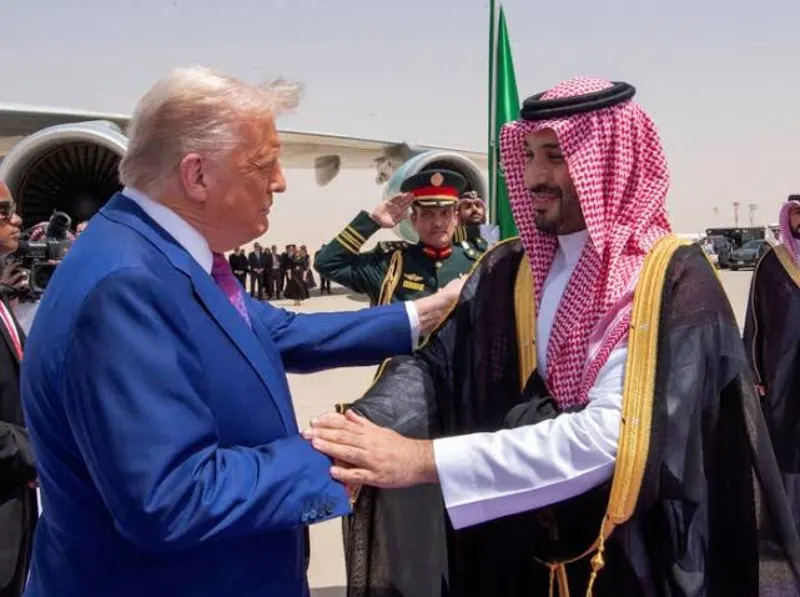
In Saudi Arabia, President Trump and Crown Prince Mohammed bin Salman signed a "strategic economic partnership" agreement, which includes a \$142 billion defense deal and a \$600 billion investment package spanning artificial intelligence, infrastructure, and energy sectors. Trump lauded the Crown Prince as "an incredible man," signaling a renewed alliance between the two nations. Additionally, Saudi Aramco announced 34 preliminary agreements with U.S. companies valued at up to \$90 billion, focusing on areas such as AI, robotics, and energy infrastructure.
Policy Shifts and Regional Diplomacy
During his visit, President Trump announced plans to lift U.S. sanctions on Syria, a move that marks a significant shift in U.S. foreign policy in the Middle East. The decision was made during a Saudi investment forum and is expected to have notable implications for U.S.-Syria relations and international dynamics in the region.
In a broader regional context, the United States and the Houthi movement in Yemen reached a ceasefire agreement on May 6, 2025, effectively ending the March–May 2025 U.S. attacks in Yemen. The ceasefire, brokered by Oman, has been hailed as a step towards de-escalation in the region.
Business Deals and Investments
The Gulf tour also saw a flurry of business deals. Qatar Airways signed an agreement to purchase 160 Boeing jets, marking a significant deal in the aviation sector. Additionally, Saudi-based DataVolt committed to investing \$20 billion in U.S. AI data centers and infrastructure, while joint U.S.-Gulf tech commitments totaled \$80 billion, involving companies like Google, Oracle, and Salesforce.
Ethical Concerns and Family Ties
The tour has not been without controversy. Reports indicate that Trump-branded residential towers in Dubai and Jeddah, a golf resort in Qatar, and investments by the Public Investment Fund in Jared Kushner's ventures have raised ethical concerns. Additionally, a planned agreement to sell semiconductors to countries in the Middle East has been criticized for potentially creating vulnerabilities that China could exploit.
President Trump's Gulf tour has underscored a strategic pivot towards strengthening economic ties and diplomatic relations with key Middle Eastern allies. While the trip has yielded substantial business agreements and policy shifts, it has also sparked discussions on the ethical implications of family business interests and the broader geopolitical ramifications of U.S. foreign policy decisions in the region.