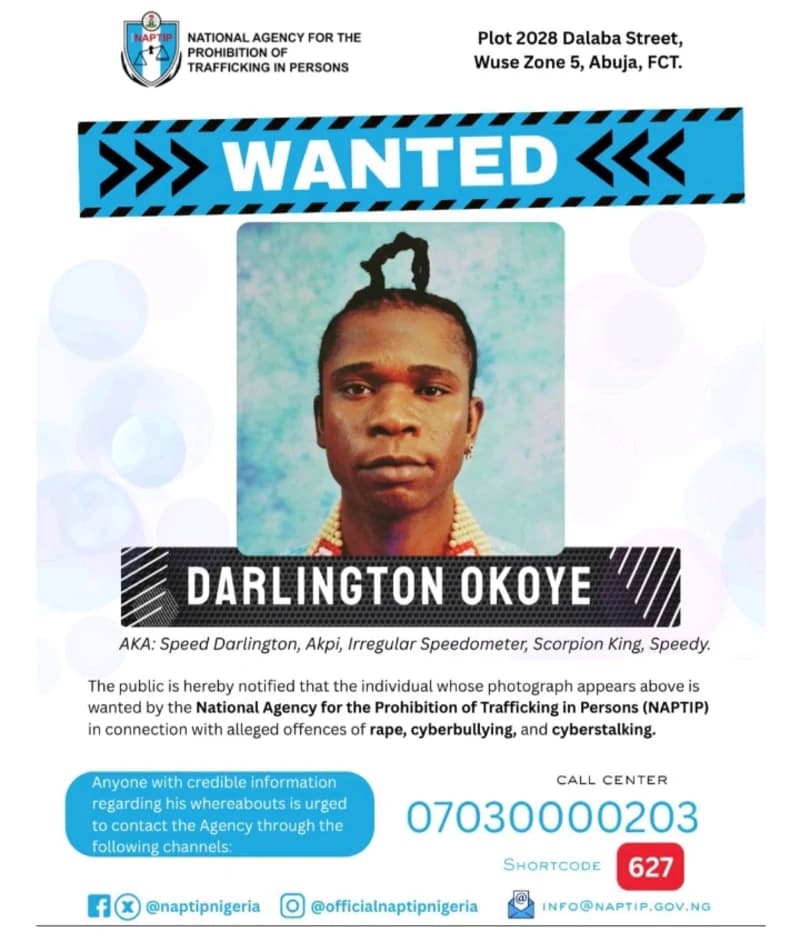
The National Agency for the Prohibition of Trafficking in Persons (NAPTIP) has declared controversial Nigerian entertainer Darlington Okoye, popularly known as Speed Darlington, wanted over serious allegations including rape, cyberstalking, and cyberbullying.
The announcement was made on Wednesday through the agency’s official Instagram page and other communication channels. The notice called for public assistance in locating the singer, who has come under fire in recent days following a disturbing video that surfaced online.
"WANTED BY NAPTIP: Darlington Okoye, aka Speed Darlington, is wanted for alleged offences involving rape, cyberbullying, and cyberstalking.
Members of the public with any relevant information on his whereabouts are encouraged to contact the agency.
Call: 07030000203 | Email: info@naptip.gov.ng,"
the post read.
The controversy was sparked by a viral Instagram Live video where Speed Darlington appeared to boast about having sexual relations with a 15-year-old girl. The footage triggered widespread outrage across Nigeria, especially because of the country’s already sensitive issues regarding child protection, sexual abuse, and the use of social media to promote harmful narratives.
In direct response to the video, NAPTIP issued an official summons inviting Mr. Okoye to appear before the agency at its Abuja headquarters for questioning. The invitation was signed by Ngamaraju Mangzha, the Head of the Cybercrime Response Team, and scheduled a meeting for 9:00 a.m. on May 30, 2025.
When Speed Darlington failed to show up for the scheduled meeting, the agency extended a final invitation, ordering him to report at 1:00 p.m. on June 2, 2025, at the NAPTIP headquarters located at 2028 Dalaba Crescent, Wuse Zone 5, Abuja.
The incident coincided with Children’s Day (May 27)—a date dedicated to the promotion of children's rights and welfare in Nigeria. The timing made the revelations particularly disturbing to the public. Civil society organizations, human rights lawyers, and advocacy groups immediately condemned the statements, stressing the need for a swift and thorough investigation.
Following public pressure and calls for action, the Lagos State Government referred the case to NAPTIP for further investigation and possible prosecution. According to the government, regardless of whether the act occurred or not, such statements—especially those coming from public figures—should not go unchecked.
Interestingly, after the backlash intensified, Speed Darlington posted a series of videos on his social media platforms claiming that the initial video was merely a publicity stunt designed to promote his upcoming music release. He insisted that his statements were fabricated for shock value and not based on real events.
Despite this claim, many Nigerians, including legal professionals and gender rights activists, argue that such comments—even if not genuine—can normalize rape culture, trivialize sexual abuse, and potentially incite similar behavior among impressionable fans. They insist that the agency must pursue the case to its logical conclusion, both as a matter of justice and deterrence.
As of now, Darlington Okoye remains at large, and NAPTIP has reaffirmed its commitment to holding perpetrators accountable. The agency has also renewed its appeal to members of the public to assist in locating the suspect.
This case continues to evolve and serves as a stark reminder of the responsibilities that come with influence—especially in the digital age.