Right to Abortion in Roe v Wade; a Legal Fiction. By Obichere Gilbert (Opinion Article)
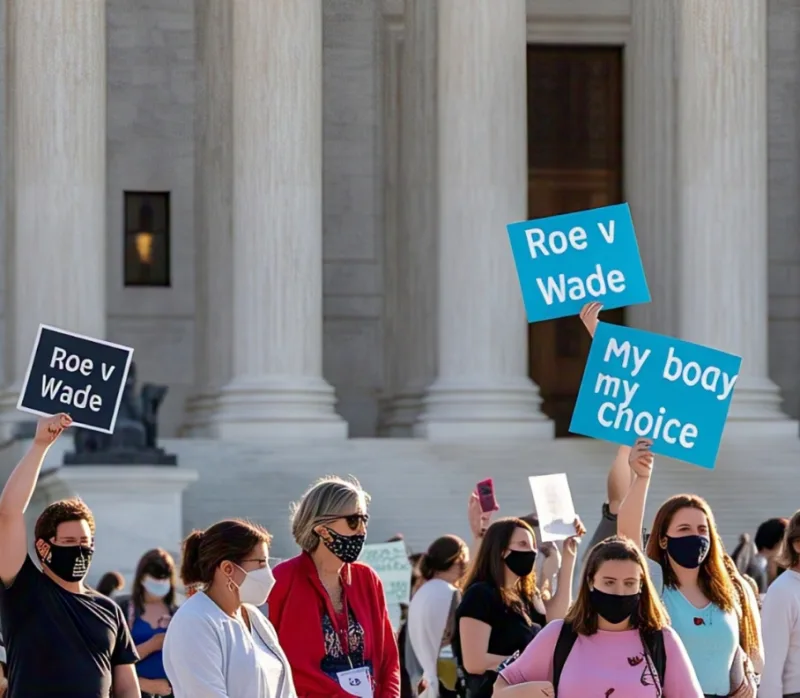
On the 24th day of June 2022, the Supreme Court of the United States (SCOTUS) delivered a judgement in the case of Dobbs v Jackson Women’s Health Organization (2022), overturning the almost 50 year old precedent set in the famous case of Roe v Wade. Roe v Wade was decided in 1973, the case inter alia decided that “a person may choose to have an abortion until a fetus becomes viable, based on the right to privacy contained in the Due Process Clause of the Fourteenth Amendment. Viability means the ability to live outside the womb, which usually happens between 24 and 28 weeks after conception.”_1. The rationale for a right to abortion is that the Due Process Clause of the 14th amendment contains a right for women (birthing people) to decide what to do with their body. The Due Process Clause provides as follows:
“No state shall make or enforce any law which shall abridge the privileges or immunities of citizens of the United States; nor shall any state deprive any person of life, liberty, or property, without due process of law; nor deny to any person within its jurisdiction the equal protection of the laws.”_2
From the above provision emerged two interpretations: Substantive and Procedural Due Process. We are only concerned with Substantive Due Process which allows the SCOTUS to give effect to rights unenumerated in the constitution. The Court deems certain unenumerated rights as protected by the constitution pursuant to the policy of Substantive Due Process. The policy was applied in the 1905 case of Lochner v New York in the guise of Economic Substantive Due Process. In Griworld v Connecticut, decided in 1965, the right to privacy was said to have emanated from the penumbras and shadowy edges of the rights enumerated. The Court, however, warned itself to tread cautiously in its reliance on Substantive due process as incorporating unenumerated rights in West Coast Hotel v Parrish which was decided in 1937. Substantive Due Process has been criticized in that by it, five unelected Justices of the SCOTUS can impose their policy preferences on the whole nation. There is no methodology for determining which right would make it under the Substantive Due Process. A lot of rights have since been incorporated such as the right for unmarried couples to use contraceptives, the right for interracial couples to marry, the right for same-sex couples to marry, the right to abortion etc. The right to physician-assisted suicide was however refused_3 The courts in “creating” these rights could be said to have usurped the powers of the legislature. Little wonder, the Supreme Court in its decision in Dobb’s case held that the right to abortion can only be created by legislation and by the legislature whether at the state or federal level.
The decision in Dobb’s case overturning Roe v Wade raised a lot of dust. President Donald J. Trump during his administration appointed some Justices to the Supreme Court. These justices are considered in political circles to be conservative leaning and as such they were all asked during their confirmation whether they would overturn the case of Roe v Wade, some of them answered in the negative. There was still the fear that Roe v Wade may be overturned. On 24th of June, the fears of the democrats and liberals came to fruition. Some liberals, both public officers and private citizens, have criticized the judgement stating that the only reason for the decision in Dobb’s case is that the Supreme Court is packed with conservatives. Some others who are aggrieved with the decision, argued that by the decision, guns would appear to have more rights than humans owing to the 2nd amendment. The 2nd amendment to the Constitution of the United States guarantees the right of citizens to bear arms. It is argued that allowing 18 year olds the right to bear arms and denying women control over their bodies gives more rights or consideration to guns than women. Top politicians have argued that the Supreme Court was wrong for asserting that the right to abortion was not intended by the founding fathers. They stated that the use of birth controls and interracial marriages were eventual developments in the law. The sentiment surrounding the decision seem to be that it has abolished the right to abortion totally in the States. Moreso, some citizens are of the view that the decision was only handed down on moral and religious grounds.
Taking all the contrary opinions seriatim, it is hardly true that the only reason SCOTUS overruled Roe v Wade is because of the political leanings of the Justices of the Court. It is true that late Justice Ruth Bader Ginsburg, even though an iconic women’s right advocate, was critical of the way the right to abortion came about in Roe v Wade._4 The right to abortion in Roe v Wade was founded on the right to privacy. It is worthy of note that there is no separate right to privacy in the Constitution. The right is “assumed” from the 1st, 3rd, 4th, 5th and 9th amendments together with the 14th amendment. It is a very far fetched argument to posit that the right to privacy derived from the foregoing amendments to the Constitution contains the right to abortion. The right to privacy was not intended by the founding fathers to cover an issue as delicate as abortion. The right have been stretched to accommodate the right to use contraceptives, gay relationships etc. As against the foregoing rights, the right to abortion affects the interests of a third party whom the states (some states in the US) seek to protect. The question becomes, how far can the right to privacy be stretched? Can it support a right for abortion? An issue as fundamental as the right to abortion should not be one that could be inferred but one that should be specifically enshrined in the bill of Rights by the legislature. The case of West Coast Hotel v Parrish where the Court cautioned itself on the effect of reading new rights into the constitution under the policy of Substantive Due Process is relevant here. The Supreme Court, in it’s decision in the Dobb’s case, rightly recognized the power of the legislature to make laws, urging aggrieved persons to channel their grievances through elected representatives. The argument juxtaposing the right to bear arms in the 2nd amendment with the right to abortion purported to be subsumed under the various amendments of the constitution is laughable at best. There is no nexus between the two rights The right to bear arms is a settled right specifically provided for in the Bill of Rights (the second amendment). The right to abortion at best is a creation by the courts. Both rights do not enjoy a similar status as to be compared with each other. The 2nd amendment cannot be a reason for the right to abortion to be codified or specifically provided for. At the risk of sounding repetitive, birth control and interracial marriages are eventual developments. However birth control does not harm anyone like abortion would, that is, assuming that the rights or interest of the third party (the foetus or child) is recognized by law. A law incriminating interracial marriages is inherently racial and discriminatory. The Equal Protection Clause is part of the Fourteenth Amendment to the United States Constitution, it provides to the effect that no state shall “deny to any person within its jurisdiction the equal protection of the laws”. As against the overall sentiment, the right to abortion has not been abolished in the United States even though Roe v Wade has been overturned. The states in the US reserve the right to legislate or codify the right to abortion in their laws. Nearly half of the states in the US allow abortion whereas the other half is against it. A person needing to procure abortion in a red state may cross state lines to a blue state and procure one even though it would become more expensive than it would be. Abortion has been argued to be healthcare. I strongly disagree because abortion is not a malaise nor disease. It is highly preventable by the use of contraceptives. It is a waste of money for the government to spend on abortion as healthcare except in rare cases such as to save the life of the mother or for rape victims. Abortion is not a constitutional right either. There’s nothing in the US constitution providing specifically for the right to abortion in the constitution. The decision to overrule Roe v Wade could not have been made on a religious or moral ground as the rationale for overruling Roe v Wade is that it is wrongly decided or that it is decided per in curiam, i.e, the law does not support the decision. There’s no question whether the right is moral or religious.
As has been pointed out elsewhere in this work, the right to abortion is an unenumerated right read into the Due process Clause of the 14th amendment. It has not been abolished in the United States as nearly half of the states provide for abortion in their laws. It behooves on individuals seeking the right to abortion in states without such right to task their elected representatives to make a law providing for and protecting that right.
JUSTIA. Roe v. Wade, 410 U.S. 113 (1973). https://supreme.justia.com/cases/federal/us/410/113/#:~:text=A%20person%20may%20choose%20to,Clause%20of%20the%20Fourteenth%20Amendment.
Cornell Law School. 14th Amendment. https://www.law.cornell.edu/constitution/amendmentxiv#:~:text=No%20state%20shall%20make%20or,equal%20protection%20of%20the%20laws.
Nathan Chapman and Kenji Yoshino. The Fourteenth Amendment Due Process Clause. https://constitutioncenter.org/interactive-constitution/interpretation/amendment-xiv/clauses/701
Buzz Staff. Ruth Bader Ginsburg’s Iconic Speech For Abortion Rights Resurfaces After Roe vs Wade. News18. June 25, 2022. https://www.news18.com/amp/news/buzz/ruth-bader-ginsburgs-iconic-speech-for-abortion-rights-resurfaces-after-roe-vs-wade-5438149.html