Introduction
On May 18, 2025, the Roman Catholic Church witnessed a historic event as Cardinal Robert Prevost was inaugurated as Pope Leo XIV. Born Robert Francis Prevost on September 14, 1955, in Chicago, Illinois, he became the first American to ascend to the papacy. His election marks a significant moment in the Church's history, bridging continents and cultures, and signaling a renewed commitment to unity, peace, and social justice.
Early Life and Religious Calling
Raised in a devout Catholic family in Chicago, Prevost felt a calling to the priesthood at a young age. He joined the Augustinian Order, dedicating himself to a life of service and spirituality. His missionary work in Peru, spanning over two decades, was marked by efforts to address social inequalities and support marginalized communities. His leadership within the Augustinian Order, culminating in his role as Prior General from 2001 to 2013, showcased his administrative acumen and commitment to the Order's charism.
Path to the Papacy
In 2014, Pope Francis appointed Prevost as the apostolic administrator of the Diocese of Chiclayo in Peru. The following year, he was named bishop of the diocese, where he navigated complex social and political landscapes. His tenure was noted for its stability and efforts to bridge divides within the Church. In 2023, Pope Francis elevated him to the cardinalate, recognizing his dedication and leadership.
Prevost's election as pope on May 8, 2025, was seen as a unifying choice, appealing to both conservative and moderate factions within the Church. His selection was also a nod to the global nature of the Church, as he is the second pope from the Western Hemisphere, following Pope Francis.
Inaugural Mass and Papal Symbols
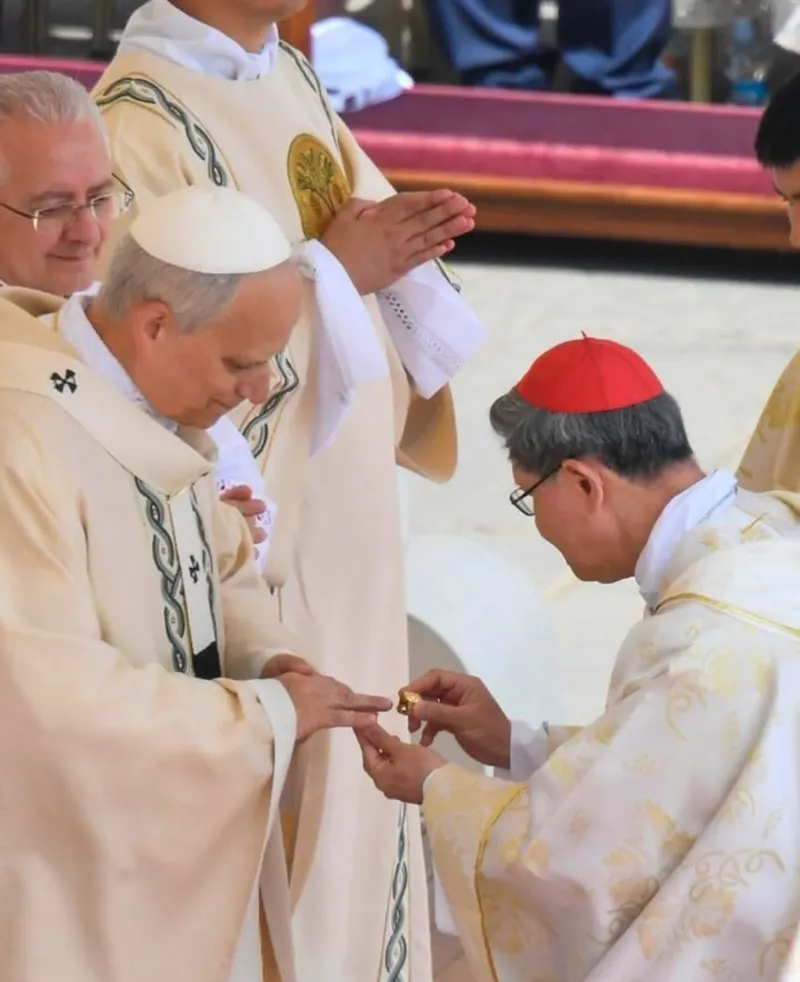
Pope Leo XIV's inauguration took place in St. Peter's Square, with an estimated 200,000 attendees, including world leaders and religious dignitaries . During the Mass, he received the traditional papal symbols: the pallium and the Ring of the Fisherman. The pallium, a woolen band placed on the shoulders, symbolizes the yoke of Christ and the pastoral care of the flock entrusted to him .
In his homily, Pope Leo emphasized themes of unity, love, and the Church's role as a beacon of light in a fractured world. He called for reconciliation within the Church and a renewed commitment to social justice, echoing the teachings of his predecessors, especially Pope Leo XIII and Pope Francis .
Global Reactions and Diplomatic Engagement
The election of Pope Leo XIV was met with widespread acclaim. Leaders from around the world, including U.S. Vice President JD Vance, Ukrainian President Volodymyr Zelensky, and Israeli President Isaac Herzog, offered congratulations and expressed hope for the Pope's leadership in fostering peace and unity .
Notably, Pope Leo XIV has expressed a willingness to host peace talks in the Vatican, particularly focusing on the ongoing conflict in Ukraine. His call for dialogue and negotiation underscores his commitment to the Church's role as a mediator in global conflicts .
Vision for the Church
Pope Leo XIV has articulated a vision for the Church that embraces both tradition and modernity. He has emphasized the need for the Church to respond to the challenges posed by the digital revolution and artificial intelligence, drawing parallels to the Church's response during the first industrial revolution .
His approach to leadership is characterized by a balance of tradition and innovation, aiming to heal divisions within the Church and promote a message of inclusivity and compassion.
Conclusion
Pope Leo XIV's papacy represents a new chapter in the history of the Roman Catholic Church. His leadership promises a focus on unity, peace, and social justice, drawing inspiration from the rich traditions of the Church while addressing contemporary challenges. As the first American pope, his journey from Chicago to the Vatican is a testament to the global nature of the Church and the enduring relevance of its message in today's world.